

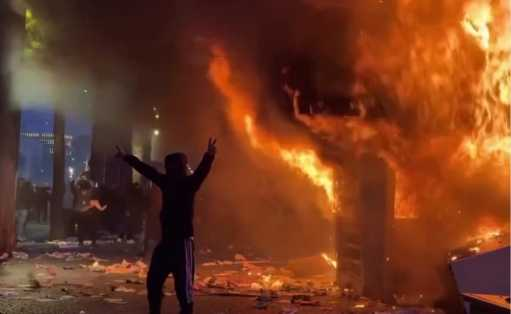
The historic Limoges Town Hall, built in 1883 and designated a landmark in 1975, was "largely lost" after masked protesters forced entry and set it ablaze on Saturday. The fire caused the roof and spire to collapse, destroying two-thirds of the exterior; the building had previously survived both World Wars and served briefly as the seat of the Belgian government-in-exile in 1940.
France’s nationwide unrest stems from weeks of student protests over deteriorating school conditions, which expanded into mass demonstrations against rising living costs and fuel prices. The country experienced some of the worst street violence it has seen in decades, drawing together a volatile mix of secondary school and university students, former "Yellow Vests," climate activists, farmers, and opportunistic groups.
On Saturday, an estimated 550,000 to 800,000 people took to the streets, with violence erupting in cities including Paris, Marseille, Lyon, and Lille.
About 1,200 to 2,000 people were arrested, over 150 police officers were injured, and widespread looting targeted shops and public buildings. In Saint-Étienne, a 17-year-old protester suffered severe injuries (losing a hand) after a police-deployed grenade detonated.
Prime Minister Sébastien Lecornu blamed the violence on "ultra-left" groups and criminals, stating the government would not be intimidated, while Interior Minister Laurent Nuñez reported that rioters had the "sole objective to burn, break and loot." President Emmanuel Macron strongly condemned the violence, vandalism, and attacks on public buildings, vowing that perpetrators would be prosecuted.
Unrest also spread to other European nations, driven by similar economic grievances. While France saw the most catastrophic structural damage, smaller or parallel protests and riots broke out in several other European countries over economic pressures and localized grievances.
In Italy, Portugal, and Belgium, Student and public groups marched against household budget constraints, housing costs, and education affordability, though reports indicate these demonstrations were less violent than those in France and Albania.
In Italy, rallies over the cost of living in cities like Milan and Bologna turned violent. Demonstrators clashed with police, forcing the temporary closure of transit hubs like the Duomo metro station in Milan and causing dozens of injuries and detentions among law enforcement and protesters.
In Liège, Belgium, demonstrations over economic strains escalated into property damage and clashes, resulting in dozens of arrests—including minors.
In Portugal, thousands marched in Lisbon over low wages, skyrocketing rents, and a severe housing shortage, setting up protest tents in Rossio square.
Student-led protests in Tirana, Albania, took on an explicitly anti-government tone, entering their fifth consecutive day of fierce clashes. Beyond standard demands for education reform and jobs, protesters called for the resignation of Prime Minister Edi Rama over corruption allegations. 35 people were wounded and 167 arrested.
The protests in Tirana, started with the controversy over a luxury coastal development project linked to an investment firm founded by Jared Kushner (son-in-law of US President Donald Trump). Police deployed water cannons and tear gas against crowds.
Across Western and Southern Europe, persistent inflation, high energy/fuel prices, and stagnant real wages have created deep financial anxiety among working-class families and the younger demographic.
Critics blame left-wing western leaders and their lax immigration and misguided energy policies. The convergence of students, union workers, and disparate political movements highlights a broader breakdown in trust regarding public institutions and the government.