


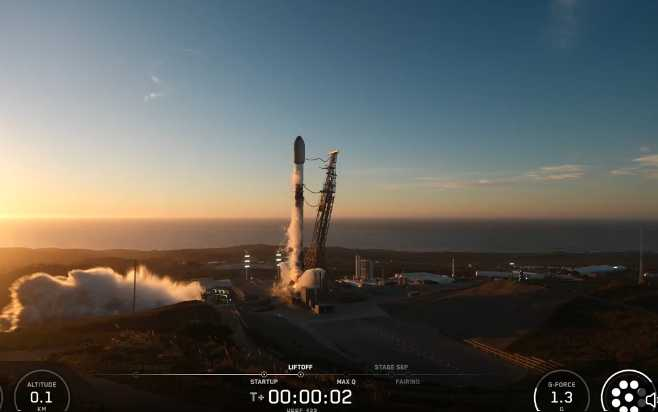
SpaceX Falcon 9 launched the classified USSF-432 mission for the U.S. Space Force from Vandenberg Space Force Base at 0048 UTC in California, marking the 119th Falcon 9 launch of the year and the 14th national-security flight.
The rocket followed a south-easterly trajectory from Space Launch Complex 4E (SLC-4E). The first-stage booster, B1095, completed its eighth flight after previously supporting the GPS III-8 mission and six Starlink launches. Following stage separation, B1095 successfully landed on the autonomous droneship 'Of Course I Still Love You' in the Pacific Ocean. The Falcon 9's upper stage, meanwhile, continued carrying its mystery payload skyward.
The mission, also designated R-4 in public documents, is part of a series of national security launches. While the U.S. Space Force and SpaceX have not officially disclosed payload specifics, analysts suspect the mission carries 23 satellites based on SpaceX’s Starshield platform—a government-hardened variant of Starlink. These satellites are believed to support the Space Force’s Space Based Sensing and Targeting (SBST) program, likely deploying into Low Earth Orbit (LEO).
Starlink is SpaceX's LEO broadband megaconstellation, which consists of more than 11,000 active satellites. Starshield is a similar system designed to provide services to the U.S. military and its allies. Starshield satellites are believed to be based heavily on the Starlink satellite bus.
The live webcast of USSF-432 was cut short approximately 10 minutes into the flight, shortly after the booster landing, consistent with standard protocols for classified missions. This launch was the 74th from California in 2026 and the 125th total SpaceX launch of the year.